
Why 2025 belongs to AI

In Short
By David Rainville, Fund Manager of Sycomore Sustainable Tech, Sycomore Asset Management

Artificial intelligence (AI) has been fuelling the conversation for over two years. Yet many investors and observers are still wondering when this technology will truly shift into high gear. The successive breakthroughs we have seen in recent years – especially in large language models (LLMs) such as GPT‑4 – have sparked a remarkable wave of enthusiasm, but there remains a certain scepticism as to whether this momentum can be sustained over the long term.
Meanwhile, a major turning point is emerging: the arrival of so-called “reasoning models,” the o-series from OpenAI, released in late 2024. These are expected to accelerate the adoption of AI and ignite a new phase of investment, making 2025 a decisive year for artificial intelligence.
FROM HYPE TO CONSOLIDATION: WHY 2025?
Since 2023 and through 2024, there has been significant buzz around AI, though it has yet to reach the scale of past technological cycles. Many observers and investors have focused on “foundation models” like GPT‑4. These are known for their ability to rapidly generate answers on a wide range of topics or to summarize very lengthy and/or complex texts, thereby delivering productivity gains. However, these models have proven useful for only a few specific cases so far.
Mass adoption of LLM technologies has, to date, been relatively limited. Investors were betting on the release of new foundation models, such as GPT‑5, to increase the number of use cases and usher in rapid adoption. But the release date for GPT‑5 is still unknown. Why? The progress has been slower than expected, due to a lack of high-quality new data to train even more intelligent models.
The media hype of the past two years has given way to new questions: Have we exhausted all the high-quality data available to train new models? Have LLMs reached their technical limits? Will AI-related spending dry up?
We believe that in 2025 these uncertainties should ease, building more confidence in the AI theme. This will be driven by two factors:
The arrival of reasoning models o1 and o3, announced at the end of the 2024, which boast much more powerful thinking and problem-solving capacities than the current foundation models. This should lead to a broader adoption of generative AI technologies by businesses.
Demand for semiconductors and memory chips will gather further speed as a result of these new applications, but also because reasoning models require much more computing and memory power than older generations.
We believe that in 2025 some uncertainties should ease, building more confidence in the AI theme
Combined, these two factors suggest a sustained growth in AI spending, potentially surpassing $250 billion in 2025 and topping $300 billion by 2026, according to our analysis.
WHAT IS A “REASONING MODEL”?
To understand why reasoning models are a turning point, we need to distinguish these newcomers from foundation models (LLMs) like GPT‑4.
Foundation models (LLM): These can be compared to vast knowledge libraries. Ask these models a question and you will receive an almost instant response extracted from the masses of information already fed into the model during its training process. GPT-4 or other LLMs such as PaLM and LLaMA are good examples within this category. These models are very good at conveying and summarising all the data they are given.
Reasoning models: Built on the same foundation as LLMs (the transformer technologies1), reasoning models go much further by introducing an extra “layer of expertise” with an ability to reason. In practical terms, instead of simply diving into their knowledge pool, reasoning models (such as o1 and o3) will break the question down into several stages, develop a problem-solving logic, and execute this strategy to find a solution – whether the problem is complex or even unprecedented.
With estimated IQs of 140 for o1 and almost 160 for o3, these models are close to achieving the concept of AGI (Artificial General Intelligence). The o3 model actually ranks among the world’s top 200 coders, beating experienced researchers (including OpenAI’s Head of research). This qualitative leap is a game changer for the adoption of generative AI technology, as it opens the door to new applications.
A FRESH OUTLOOK FOR INVESTMENT
1. A new training and data creation phase
Up to now, AI model training has relied on huge amounts of text, images, and audio from the internet and other sources. Several AI labs (and many investors) worried that we were about to run out of “high-quality data,” threatening the continual improvement of LLMs.
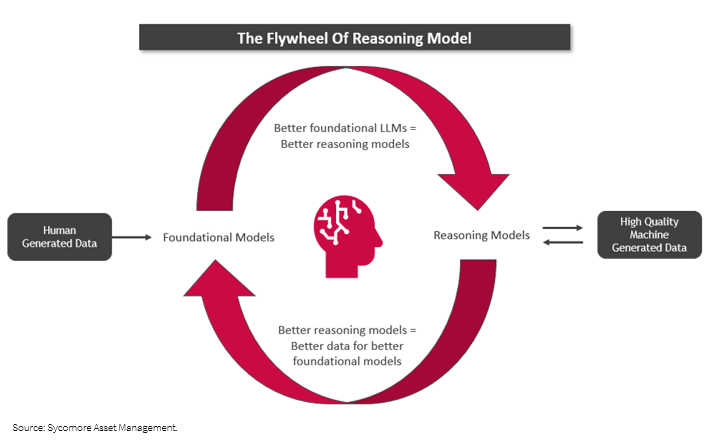
However, the arrival of reasoning models could upend that equation. Thanks to their ability to reason and generate more structured content, o1 and o3 may themselves produce “synthetic data” that will be used to train future base models. In other words, we are about to witness a virtuous cycle in which AI helps enrich the data needed for its own evolution.
Download the full publication:
1 The transformer is a novel neural network architecture based on self-attention mechanism and used for the processing of natural language.
Opinions, estimates or forecasts regarding market trends or changes in the risk profile of issuers are based on current market conditions and are subject to change without notice. Sycomore AM makes no commitment that they will be achieved. We believe the information supplied in this article to be reliable but should not be considered exhaustive. We remind readers that forecasts have their limitations and that as a result, Sycomore AM offers no guarantees that these projections will materialise.
References to specific stocks and their issuers are for illustrative purposes only and should not be construed as recommendations to buy or sell these stocks.